An Industrial Safety Course is a really solid choice for a career path in our fast-paced industrial landscape. These courses teach people about dangers at work, how to follow safety rules, and ways to handle risk. Moreover, that makes them incredibly useful for any company.
However, if you pick a course that also helps with job placement, generally that’s a huge bonus. Similarly, you get the technical know-how, and it often smooths the path to landing a job faster. Similarly, this kind of course really suits students, anyone looking for work, or even folks already in a job who are hoping for a steady, well-regarded career path.
What Exactly is an Industrial Safety Course?
Basically, a professional training program designed to teach you about managing safety, commerce, stopping accidents before they happen, and controlling risk in industrial settings. Not only that, the main idea is to develop people who really know how to keep things safe and reduce risks in the workplace.
Why is an Industrial Safety Course So Important?
Especially, these Companies often look for folks who’ve finished one of these courses, simply because they come in already knowing the Safety steps and how to head off risk.
Furthermore, however, these organisations and these courses can really help them.
- Reduce accidents and injuries.
- Make everyone more aware of Safety at Work.
- Steel is compliant with all those safety laws.
- Boost productivity by making sure everyone works safely.
Finally, compared to all those advantages, it’s no wonder that an industrial safety qualification has become pretty much essential in a lot of industries.
What About an Industrial Safety Course That Helps You Find a Job?
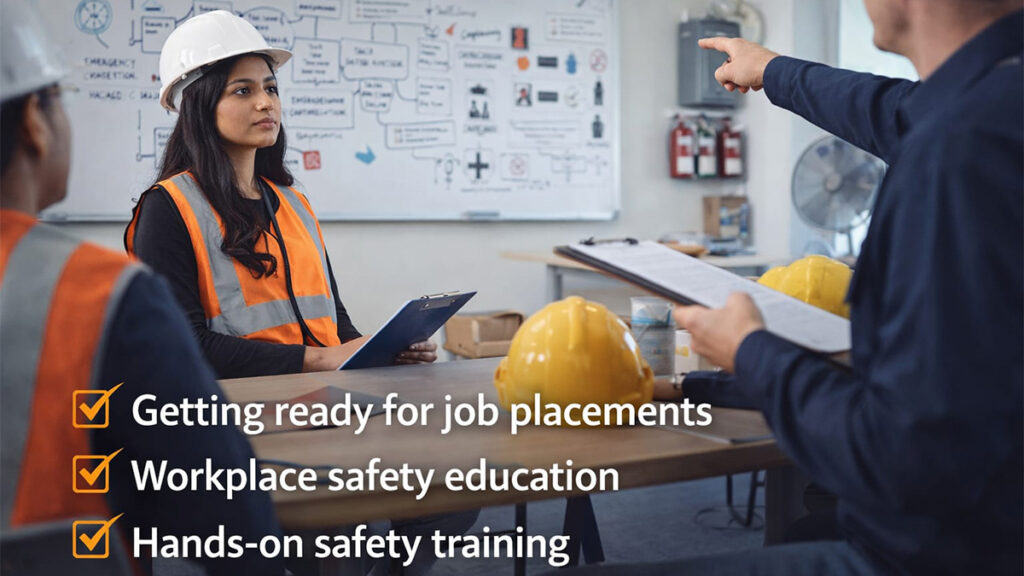
If you are a student hoping to jump straight into a job, a safety course that includes placement assistance can be super helpful. These places that offer these courses often provide support, walking students through the whole hiring journey.
Similarly, some of the good things about a safety course with job placement Help are:
- Getting ready for interviews once your course is done.
- Working on your resume while you are still studying.
- Potentially getting direct job leads right after you finish.
- And getting a real taste of the industry through hands-on training.
Essentially, a safety course with placement assistance tries to make sure your education directly translates into actual career steps.
Who can Actually Take One of These Courses?
The Requirements for getting into an Industrial Safety Course are usually pretty straightforward and flexible.
It’s an advanced school; college degrees are generally preferred.
And for a postgraduate safety course, you will definitely need a bachelor’s degree.
Ultimately, anyone who’s keen on safety and handling risk & up for one of these courses.
Are there different kinds of Industrial Safety Courses?
You will find a few different kinds of industrial safety programs out there:
- A diploma course: This usually goes over the basic safety ideas and gives you some hands-on training.
- An advanced course: Here’s the focus shift to a more complex safety management system and all the relevant rules.
- Fire and Industrial Safety Course: Although this one is all about preventing fires, it also teaches how to respond in an emergency.
- And a postgraduate course: Most importantly, these are often best if you are aiming for leadership or management positions.
However, picking the best course really comes down to what you’re hoping to achieve in your Industrial Safety Course career.
What does an Industrial Safety Course Actually Cover?
Just as these courses usually pack in a mix of both classroom theory and practical topics, like:
- Understanding safety management.
- Fire and safety engineering.
- How to spot hazards
- Doing risk assessments.
- Occupational health and safety.
- Keeping the environment safe.
- And all the industrial laws.
Besides, the idea behind the syllabus is to make sure you are fully prepared and ready for the industry to work and get experience.
What Kinds of Jobs Can You Get After Taking One of These Industrial Safety Courses?
In addition, finishing an Industrial Safety Course can really open doors to a bunch of different career paths. Industries are often on the lookout for people who have this kind of safety qualification.
Whereas, some common rules you might step into after a safety course are:
- A Safety Officer.
- A Fire Safety officer.
- A HSE Manager.
- A Safety supervisor.
- Or even a safety auditor.
What Skills Do You Actually Pick Up From an Industrial Safety Course?
While taking an Industrial Safety Course helps you build some really valuable professional skills, such as
- Knowing how to assess risk.
- Handling emergencies.
- Although making sure things comply with safety rules.
- And improving your communication skills.
Likewise, These Are the kinds of skills that make a safety course incredibly valuable across just about any industry.
What Does the Future Look Like for Industrial Safety Careers?
The outlook for Industrial Safety Courses seems pretty bright. However, as industries grow and pay closer attention to safety and meeting compliance standards, as a result, the need for people with the qualification is just taking off.
Overall, these courses can even open doors to jobs overseas, most importantly, which means it’s a career choice with a global reach. As industries keep expanding, industrial safety qualifications will likely stay very much in demand.
FAQs
1. When we consider an Industrial Safety Course, what exactly are we getting into?
However, it’s a program designed to teach you all about keeping workplaces safe and managing potential risks.
2. Who might find themselves posing one of these courses?
Well, if you have a basic education, you are generally good to go for enrollment.
3. How long does it take to complete this course in a year or months?
However, if you’re usually looking at something between 6 months and 2 years, duration-wise, in this course.
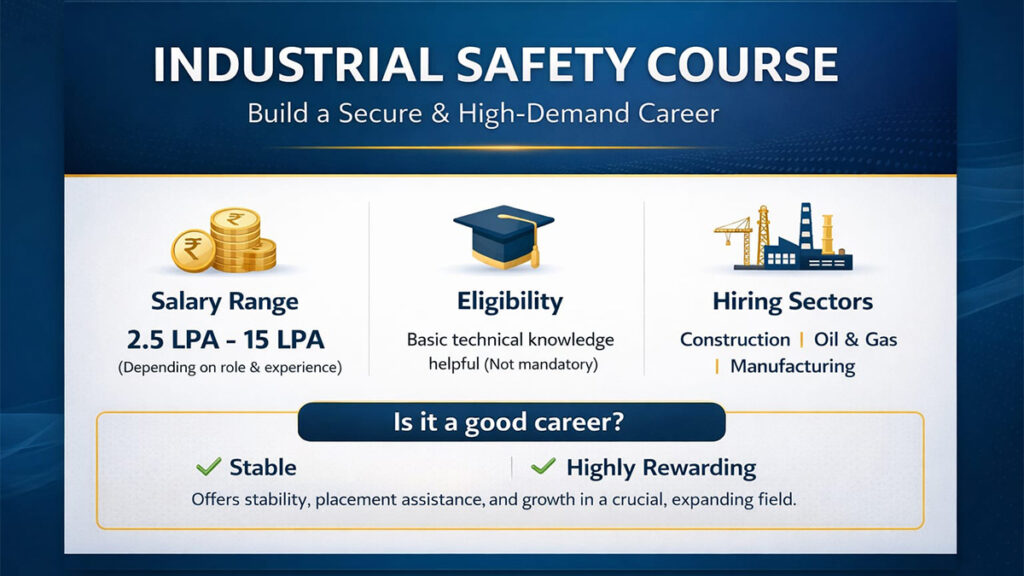
4. Which of the sectors is typically on the hunt for professionals with these specific safety skills at work?
In the same way, most important industries like construction, oil and gas, and manufacturing usually become big recruiters for industrial safety experts.
5. Is an industrial safety course a solid choice for a career path?
It certainly looks that way, offering opportunities that are both stable and potentially very rewarding. Ultimately, an industrial safety course can be a really strong foundation for a secure and thriving career. And if you find the right course that also helps you with placement, just as you could really set yourself up in a field that is both crucial and expanding.